Can You Remove a Fake Google Review? What Works & What Doesn't | LiftBrand
Quick answer: You can get a Google review removed only if it violates Google's content policies. Google says you can report any review, but only those that break its rules are eligible for removal, and disliking or disagreeing with a review isn't enough. So the method is: work out which policy the review breaks, report it under that reason, track the report, use the one appeal Google may allow, and reply publicly while you wait. Be wary of anyone who offers to delete reviews for a fee. Google's policy bans paying for removals.
First, calm down: a fake review isn't a death sentence
If you're searching for this because a competitor or troll just hit your profile, you're probably angry and a little scared. That's normal. Here's the context that should help.
Google says it blocked or removed over 292 million policy-violating reviews and removed over 13 million fake Business Profiles in the most recent year it reported (post dated April 2026). It also says it now stops many suspicious posts before they go live and alerts owners when there's a spike in spam reviews. Fake reviews are a known problem, and there's a real process for dealing with them.
What matters now is using that process correctly, because most of the advice online skips the part that decides whether a report works: which rule the review actually breaks.
What Google will remove
Google's Maps content policy lists what's not allowed. The categories most relevant to fake and troll reviews:
Fake engagement. Google says it "is not allowed and will be removed." Reviews must reflect real experiences.
Conflict of interest. Content based on employment, contracts or personal or professional ties to the business, including, according to the policy, content posted on a competitor's business to undermine its reputation.
Rating manipulation, incentivized or paid reviews.
Off-topic content. Reviews should be based on an experience at the location, and general political or social commentary isn't.
Harassment, hate speech and personal information. Threats, doxxing and posting personal info without consent are banned.
Offensive content. This includes "unsubstantiated allegations of unethical behavior or criminal wrongdoing."
Impersonation and misrepresentation.
Advertising and solicitation. No promotions, contact details or links in reviews.
Unclear and repetitive content, such as meaningless strings or repeated posts.
If the review fits one of those, you have a case. If it doesn't, you don't, however unfair it feels.
What Google will not remove
Google is explicit on this point. On its page about reporting reviews, it says: "You can report any review, but only those that violate Google policies are eligible for removal", and "Do not report a review just because you disagree with it or dislike it." Google adds that negative reviews "can highlight areas for improvement and aren't always a sign of poor service."
In practice, these usually stay up:
A harsh but honest opinion about a real experience.
A review that's wrong on the details, such as the wrong date or an exaggeration, but is from an actual customer.
A one-star rating with no text.
A bad review that's accurate and unflattering.
You can't remove those by reporting them, so the job becomes responding well. See our guide on how to respond to a negative review.
How to report a fake Google review, step by step
Identify the policy it breaks. Read the review, then match it to a category above. A competitor's review is a conflict of interest and possibly fake engagement. A review about a business you've never had dealings with may be fake engagement. A review full of insults is harassment or offensive content.
Collect your evidence. Customer records, no matching transaction, the date, screenshots and any pattern, such as several one-star reviews from new accounts at once. Keep copies before you report.
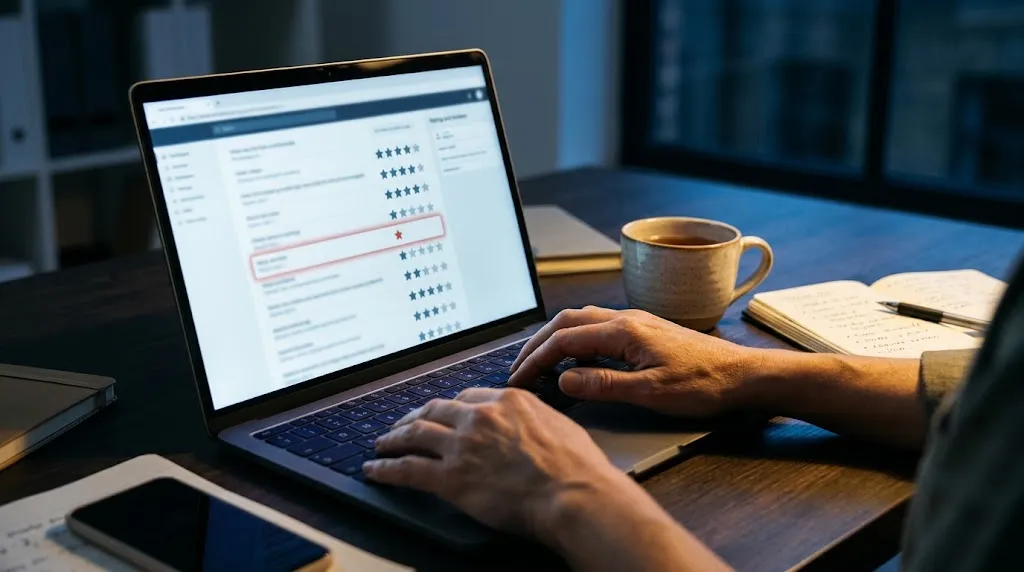
Report it from your Business Profile. Go to your profile, select Read reviews, find the review, select Report, choose the reason and select Send report. On Maps, use the three-dot menu on the review and choose Report Review.
Choose the most accurate reason. Pick the policy that best fits. Don't select a reason you can't back up.
Track the status. Reports show up as statuses in the Reports section of Google Maps (for example, "Processing report"). Google says review evaluation typically takes several days.
Appeal once if denied. If the content stays up, Google's Maps page says you may be eligible to submit one appeal. Add anything you didn't include the first time.
Reply publicly in the meantime. A calm reply helps whether or not the review is removed. More on this below.
Why reports get denied
Reports usually fail for a few predictable reasons:
The review doesn't actually break a policy. It's negative, not fake.
The wrong reason was selected. The review is a conflict of interest, but the report says "off-topic."
No evidence of a pattern. A single review looks like opinion; several suspicious ones from new accounts look like an attack.
The claim can't be shown. "I'm sure they were never a customer" is not proof, and Google isn't in a position to check your records.
Google also says it may reinstate or remove content regardless of whether your report was accepted, so a denial isn't always the last word. I haven't found a published success rate for reports, so treat anyone quoting one with suspicion.
What doesn't work (and can make things worse)
Most of the bad advice online falls into these traps.
Replying with accusations. Calling a reviewer a liar or threatening them doesn't get the review removed. The FTC's staff guidance on its review rule says the rule prohibits making a false accusation about a reviewer if you know it's false and prohibits threats, intimidation and groundless legal threats used to get a review removed.
Offering money or discounts to delete it. Google's policy lists incentives, such as payment, discounts or free goods, offered for reviews, revisions or removals of negative reviews among things not allowed. The FTC also says paying consumers to change or remove truthful negative reviews may violate the FTC Act.
Paying a "review removal service." If a company promises guaranteed deletions, ask how. Google says it has seen attempts to demand payment in exchange for removing fake one-star reviews. Be especially careful of anyone who contacts you first.
Posting fake five-star reviews to bury it. Google lists fake engagement, rating manipulation and incentivized reviews as policy violations. Google says that if a business is found violating this policy, it may remove the reviews and place restrictions on the Business Profile, such as blocking new reviews for a period.
Asking friends and staff to flag the review. There's no shortcut in volume; the question is whether the review breaks a rule. Write one accurate report instead.
Reporting a review you simply dislike. Google says not to.
When a fake review might be a legal issue
Some fake reviews go beyond policy violations and make false statements of fact that harm your business. That can raise legal questions, such as defamation. Google's help pages list a "Legal Removals" process, but I haven't verified the details, and legal outcomes depend on your facts and your state. If the review makes serious false claims, or if there's a pattern of coordinated attacks or extortion, document everything and talk to a lawyer.
A related question is whether a competitor posting fake reviews violates the FTC's review rule. That rule covers fake and false reviews and the buying and selling of them, and it makes ordinary consumers' own reviews outside its liability. Whether it reaches a specific competitor's conduct is a legal question. This isn't legal advice.
The best long-term defense: more real reviews
Even a perfect report only removes one review. What protects you is volume and recency. A profile with dozens of recent, genuine reviews barely notices one troll. The right way to build that is to ask every customer, with the same neutral request and the same direct link, not to filter for happy ones. Our guide on whether review gating is illegal explains why that matters.
Also reply to the fake review. A short, calm response tells readers you're a real business with real customers, and it helps whether or not the review comes down. Something like:
"Hi, we can't find a record of a visit or order matching this review and we'd like to look into it. If you were a customer, please contact us at [contact] so we can make it right."
Don't accuse them of lying in public, and don't share any customer details.
How LiftBrand helps
Our reputation tools include monitoring across Google, with alerts when your brand is mentioned, AI-drafted review responses, and workflows to follow up with dissatisfied customers, according to our site. See Reputation Management or our packages.
Frequently Asked Questions
Can you remove a fake Google review?
Yes, if it violates Google's policies. Google says you can report any review, but only those that violate its policies are eligible for removal. Disagreeing with a review, or not liking it, isn't enough.
How do I report a fake Google review?
From your Business Profile, select Read reviews, find the review, select Report, choose the reason and select Send report. You can also use the three-dot menu on Maps and choose Report Review. Pick the policy that most accurately fits and keep your evidence.
How long does it take Google to remove a fake review?
Google says review evaluation typically takes several days. It doesn't publish a guaranteed timeline, and I haven't found a published success rate.
What happens if Google denies my report?
If the content stays up, Google says you may be eligible to submit one appeal. Review the policy list, make sure you chose the right reason and add any evidence you left out. Reply publicly in the meantime.
Can I pay someone to delete a bad Google review?
Don't. Google's policy lists incentives offered for removing negative reviews as not allowed, and the FTC says paying consumers to change or remove truthful negative reviews may violate the FTC Act. Google has also described attempts to demand payment in exchange for removing fake one-star reviews as a scam pattern.
Can I delete a bad Google review myself?
No. Only the reviewer, or Google after a policy review, can remove a review. You can reply to it, report it if it breaks a policy, and build more genuine reviews around it.
What if a competitor posted the fake review?
That can violate Google's policy on conflicts of interest, including content posted on a competitor's business to undermine its reputation. Report it under that reason with your evidence, and talk to a lawyer if the false claims are serious. See Google's content policy.
Will a fake review hurt my rankings?
I haven't found a source showing how a single fake review affects your ranking, so I won't promise either way. What's clear is that a profile with many recent, genuine reviews is more resilient than one with only a few. See our guide on responding to negative reviews.